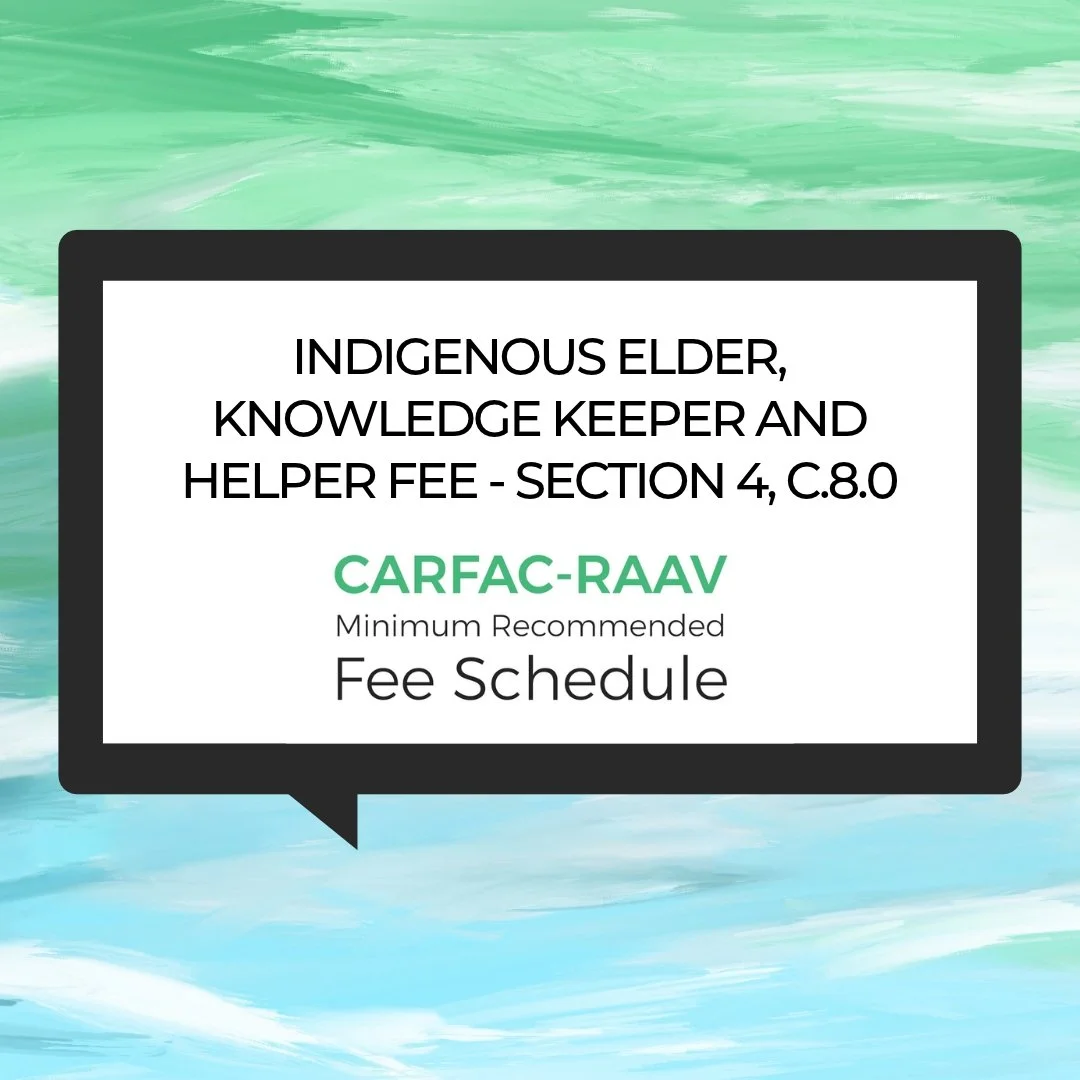
CARFAC National is proud to announce that fees for Elders and Knowledge Keeper’s services in the visual arts have been officially approved and are now live as part of the CARFAC-RAAV Minimum Recommended Fee Schedule!
The three new fees were presented at CARFAC National’s Annual General Meeting on September 27, 2026, and passed by a unanimous membership vote.
The CARFAC-RAAV Minimum Recommended Fee Schedule establishes minimum standards for the professional labour of visual artists within Canada's visual arts sector. As artistic practices and institutional relationships continue to evolve, the Fee Schedule now also recognizes the distinct and essential role of Elders and Knowledge Keepers providing their services alongside visual arts programming.
Across Canada, Elders and Knowledge Keepers are increasingly invited to contribute to exhibitions, public art projects, residencies, public programming, advisory committees, mentorship, protocol guidance, community engagement, and other visual arts initiatives. While some of these contributions may overlap with existing speaking or consulting fees, the role of an Elder extends beyond professional services previously reflected within the Fee Schedule.
Elders contribute invaluable cultural knowledge, lived experience, ceremony, language, and traditional teachings that are fundamental to guiding and producing many visual arts projects. While these contributions cannot be measured solely in economic terms, the time, expertise, and labour they represent are now recognized through dedicated minimum recommended fees, officially incorporated into Section 4, Professional Fees, as Subsection C.8.0, and available online. As always, we encourage organizations and presenters to pay above the minimum recommended fees.
This placement reflects the nature of the services being compensated. Like the other categories in Section 4, the Indigenous Elder Fee Schedule establishes minimum recommended fees for professional services provided in connection with visual arts programming. Elders are engaged for their time, expertise, knowledge transfer, guidance, mentorship, and community leadership in support of exhibitions, residencies, public programs, and other visual arts initiatives. As such, these services are most appropriately recognized as professional service fees.
In addition to professional fees, the Fee Schedule acknowledges that many Indigenous communities observe cultural protocols that may include offering a gift or other expression of respect. Such gifts are distinct from monetary compensation and should never replace fair payment for an Elder's time, knowledge, and labour. Organizations should follow the guidance of the Elder they are engaging and local community protocols where appropriate. Please refer to the full Advisory Note for more information, as well as the Buy Authentic toolkit.
With this work, we also remind presenters and hosts that engaging with Elders and Knowledge Keepers is relational, not transactional. We encourage everyone to put in the effort to build long-term, trusting relationships when appropriate. Payment and gifting are means of acknowledging the time, preparation, and spiritual labour involved in sharing knowledge. Relationship building, trust, and ongoing communication are essential.
CARFAC National and the Indigenous Editors Association developed this work to recommend minimum rates and best practices for compensating Elders and Knowledge Keepers who share their time, knowledge, and cultural guidance in the visual arts sector. These recommendations are based on interviews with vetted Elders, Knowledge Keepers, and Indigenous arts administrators across Canada. They reflect the principles of reciprocity, respect, and relational accountability that underpin Indigenous knowledge systems. The accompanying Advisory Note is a living document, intended to evolve as community feedback and practices develop.
CARFAC National sincerely thanks the Indigenous Editors Association, the Indigenous Protocols Collective, and all contributors from coast to coast to coast. We’d also like to thank our Program Director, Larissa Desrosiers, for her leadership and dedication in bringing this important project to fruition.